

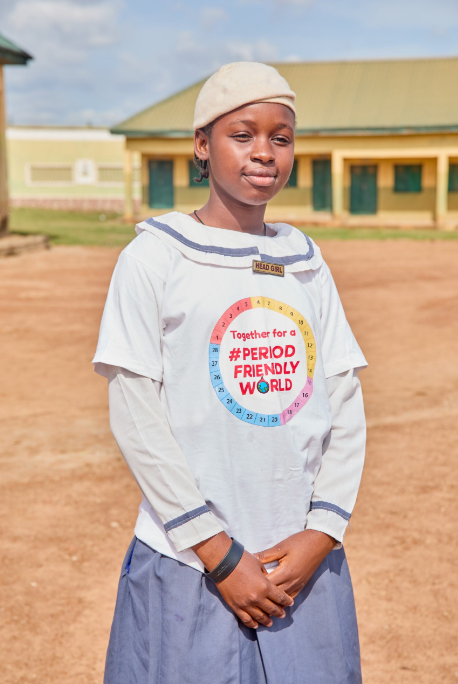
From silence to leadership, Francisca’s journey is one of courage and change.She overcomes menstrual hygiene challenges and builds confidence through learning.Now she empowers other girls in her community.
Seventeen-year-old Chukwuma Francisca knows what it feels like to miss school because of her period. Growing up in Kagini, a community in Abuja’s Federal Capital Territory, she and many of her schoolmates would stay home for days each month, struggling with the pain that came with menstruation, and sometimes unable to afford sanitary pads. The discomfort was real, and the embarrassment was perhaps harder to bear. For a long time, Francisca stayed quiet about it. This is no longer the case.
Francisca attends Government Secondary School, Kagini, where she serves as head girl. Confident, smart, and dependable, she is the kind of young woman her teachers and classmates look to for direction. Beneath that confidence, however, lies a story of the struggle that she now speaks about openly, because she understands that her silence has never solved anything.
It was through the Girl-Led Research Project that everything changed. Francisca first heard about it from classmates who mentioned that an organisation was looking for girls willing to speak up and take action regarding issues that affected them. She approached the teacher in charge, Ms Loveline, and with her mother’s permission, she joined. What followed was a turning point. Through the project’s training, Francisca learned to name the challenges that had quietly shaped her life, including menstrual hygiene and period poverty. She gained practical skills in managing menstrual pain and, crucially, learned how to make reusable sanitary pads, a skill that offered a real, affordable solution to a problem that had kept too many girls out of school.
Francisca did not keep that knowledge to herself. She led step-down trainings for over 50 girls in her school, teaching them how to produce their own reusable pads and helping them understand that menstruation is not something to be ashamed of. She also helped organise a community rally on World Menstrual Hygiene Day, bringing the conversation about menstrual health into the open and encouraging others to see it for what it is: a health matter, not a source of embarrassment.
Today, Francisca speaks freely about menstruation with her classmates, teachers, and community members. She has become a role model for girls in Kagini, demonstrating that when young women are given the right knowledge and support, they do not just survive their challenges, they turn them into platforms for change. Her mother, who raised her alone and has always considered her the joy of her world, has expressed deep pride in the leader her daughter has become.
As the world commemorates World Menstrual Hygiene Day on the 28th of May 2026, Francisca’s story stands as a reminder of why this day matters. Period poverty is not a Nigerian problem alone; it is a global crisis. Every month, more than two billion people around the world menstruate, yet millions cannot afford menstrual products or access safe water and sanitation to manage their menstrual health and hygiene. Closer to home, a 2023 UNICEF report found that 23% of adolescent girls in Nigeria had missed school due to menstruation. Behind every one of those statistics is a girl like Francisca: capable, determined, and deserving of the tools and knowledge to manage her health with dignity. She found her voice. The question the day asks of all of us is whether we are doing enough to ensure every other girl can find hers too.
Francisca should not have had to learn to sew a pad just to stay in school. No girl should. We are all called to act, governments, communities, schools, and individuals alike, because building a #PeriodFriendlyWorld is a shared responsibility. The Federal Government of Nigeria has both the power and the duty to lead by making sanitary pads free and accessible to every schoolgirl in the country. Teachers should create safe spaces where girls speak openly. Communities should dismantle the shame that silences them. Every one of us has a role to play, and until we do, girls across the country will continue to choose between their education and their dignity. That is a choice no child should ever have to make.
Together for a #PeriodFriendlyWorld.