
Evidence from the RWVL Nigeria Baseline Political Economy Analysis
Ask most people why Nigeria has so few women in political office, and you will probably hear the same answers.
Culture. Tradition. Religion. “That’s just how things are here.”
And there is truth in that. Social and cultural norms continue to shape how women are perceived, where they are expected to belong and whether their leadership is accepted.
But a new Political Economy Analysis conducted under ActionAid Nigeria’s Renewed Women’s Voice and Leadership Nigeria project tells a bigger story.
Culture is not the whole story.
There is money. There are political networks. There are gatekeepers. There is information that does not reach everyone. And there are systems that can keep a woman out long before anyone gets to the ballot box.
That matters because if we continue to explain women’s political exclusion mainly through culture, we risk designing solutions for only part of the problem.
These Statistics Will Shock You
Women make up 47.5% of Nigeria’s 93.4 million registered voters. That is almost half of the country’s registered voting population. Yet the PEA notes that this huge voting community has not translated into commensurate gains for women in election outcomes.
Nigeria’s representation gap is stark. The PEA cites the UN Women and Inter Parliamentary Union ranking, which places Nigeria 179th out of 185 countries for the percentage of women in elective positions.
So here is the question the numbers leave us with: if women are almost half of the registered electorate, why does that strength disappear when we get to political power?
The answer is not as simple as culture.
Politics Starts Costing Money Before the Campaign Starts
One of the most striking findings in the PEA is the weight of financial exclusion.
Among civil society and women’s rights organisation respondents, 78% ranked limited financial resources as the most significant barrier to women’s participation. Among private sector respondents, 49% described access to credit for women entrepreneurs as difficult or inaccessible.
The report goes further. Women-owned businesses make up more than 40% of early-stage small enterprises, yet over 98% operate outside the formal credit market. The PEA connects this economic insecurity to women’s ability to build the resources needed to navigate political gatekeeping.
The rising cost of entering Nigeria’s political arena makes this barrier even more concrete. Nomination and expression-of-interest fees have climbed sharply since 1999, when major parties charged less than a million naira for both forms combined. Heading into the 2027 election cycle, those fees alone range from roughly ₦25 million for a governorship ticket to as much as ₦100 million for a presidential ticket, depending on the party, before a candidate spends a single naira on the wider campaign. Nigeria’s Economic and Financial Crimes Commission has separately disclosed that some governorship aspirants spent between ₦20 billion and ₦30 billion in total securing their party’s ticket alone. (Source: The Guardian, “Concerns over boom in money politics as 2027 polls beckon”)
And this is not just about having enough money to print posters or organise a rally. The PEA’s findings show that financial insecurity affects the everyday costs of participation too. Women spoke about needing resources to attend meetings, participate in community dialogues, contest political positions and maintain engagement with political parties.
Think about what that means. A woman does not necessarily have to lose an election to be excluded. She can be excluded because she cannot afford to enter the race in the first place.
Then There Is the Room Behind the Room
Money is only part of the story. The PEA describes another form of exclusion that is harder to see because it does not always happen in official political spaces.
It calls it “the room behind the room.”
The report describes how important political decisions are often shaped through informal networks, private meetings, social gatherings and back-channel negotiations. Candidate selection, party strategy and policy compromises can be negotiated in these spaces before they reach the formal table.
And women are often not in those networks. That creates another kind of political disadvantage. A woman may eventually get a seat at the formal table, but if she was not part of the conversations that happened before the meeting, she may arrive without the information, relationships or influence needed to shape the outcome.
The PEA describes these informal networks as a structural mechanism of exclusion, particularly within a political environment shaped by patronage and male-dominated spaces.
This is where the familiar explanation of “culture” begins to feel incomplete. Because we are no longer talking only about whether people believe women should lead. We are talking about who controls access to information, money, relationships and political opportunity.
The Gate Is Bigger Than the Ballot
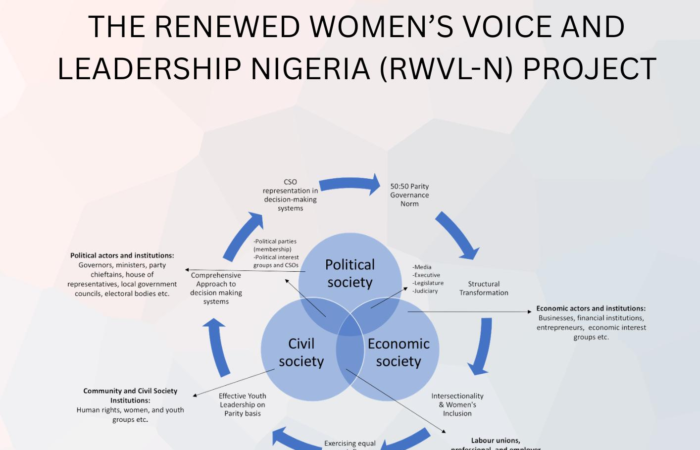
The PEA describes women’s political participation as being shaped by an interaction of institutional, social and economic constraints.
Social norms still prescribe women’s roles as domestic rather than political. Financial constraints limit their ability to fund campaigns and even participate in political activities. Political structures and informal networks determine who gets access to opportunities. And weak institutional accountability can allow exclusionary practices to continue.
The result is not one barrier standing between women and political power. It is several barriers reinforcing one another.
A woman who lacks economic independence may struggle to enter political networks. A woman outside those networks may have less access to information and political support. Social expectations can make her leadership less accepted. And political institutions can fail to create the conditions needed for meaningful participation.
That is much more complicated than saying, “Nigerians don’t want women in politics.”
What This Changes
This is where the PEA becomes particularly useful. If women’s political exclusion is shaped by more than social attitudes, then the solutions have to go beyond changing attitudes too.
It means looking at who has access to money and who does not. Who gets into the political networks where decisions are made. Who has access to information. Who gets support from political parties. And who has the power to open or close those spaces.
The PEA points to several pathways for change, including economic empowerment, sustained engagement with political and community structures, stronger engagement with political parties, accountability and monitoring, and movement building. It also recommends approaches that include greater access to economic opportunities, stronger networks and movement building, gender scorecards for political parties and consideration of state funding for electoral campaigns.
The point is not that there is one solution. There isn’t. The point is that if the barriers are interconnected, the response has to be interconnected too.
And that may be one of the most useful things this PEA offers. It gives us a way to stop looking at women’s political participation as a single problem and start looking at the system around it.
The PEA Gives Us a Different Starting Point
The most useful thing about this research may not be any single statistic. It is the shift in how we understand the problem.
Women are not simply absent from political spaces because they lack ambition. They are not simply absent because voters reject them. And they are not simply absent because of culture.
They are navigating an ecosystem where money matters, networks matter, information matters, political parties matter, gatekeepers matter and social norms still matter.
That is the conversation the PEA is asking us to have. Because how we understand the problem shapes what we choose to do about it. The PEA provides evidence for looking beyond individual women and asking harder questions about the systems around them.
Who controls access? Who gets resources? Who makes decisions? Who is missing from the room? And what would it take to change that?
The answers will not come from one intervention or one organisation. But we cannot change what we do not fully understand. And perhaps that is the real value of the PEA. It gives us a fuller picture of the problem, and a stronger starting point for thinking about what comes next.
Culture did not build that gate alone. A system did. And systems, unlike culture, can be changed on purpose.
The Research Behind the Story
The RWVL Nigeria Political Economy Analysis was based on mixed research methods, including literature review, structured surveys, key informant interviews, focus group discussions and expert workshops.
The research surveyed 9,000 stakeholders across five sectors nationwide between 5 February and 16 March 2026, alongside 27 key informant interviews and 28 focus group discussions in RWVL focal states and the FCT.
The PEA examines the political, economic and social structures shaping women’s participation and leadership in Nigeria and provides evidence that can support more informed programming, advocacy and engagement.
For a deeper look at the evidence, findings and recommendations, read the full RWVL Nigeria Political Economy Analysis (PEA) Report.